Ferrari Challenge Parts: What Sets Them Apart — and Where to Source Them
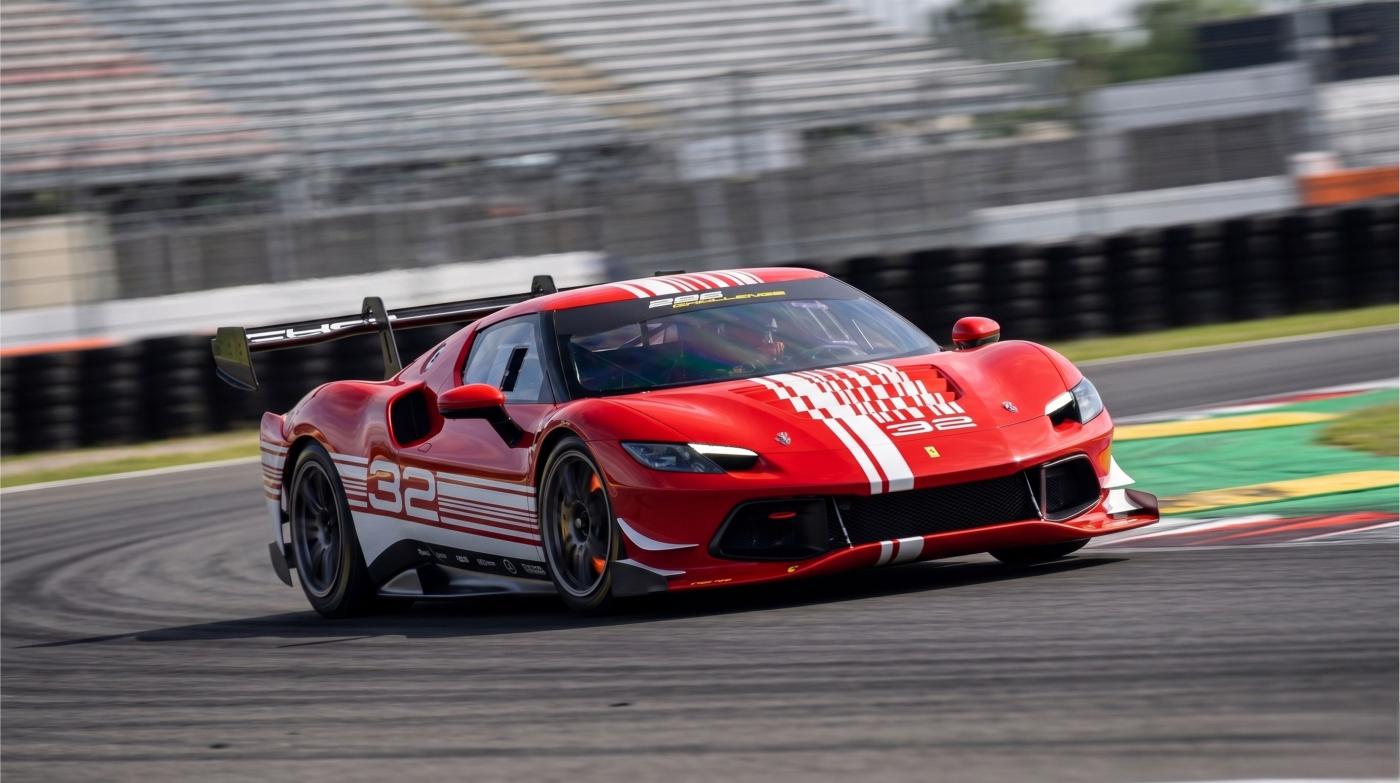
Owning a Ferrari Challenge car sits in a category of its own. It is not a GT3 machine maintained by a professional outfit, and it is not a road car with a dealer around the corner. It is a factory-built race car handed directly to you — the client — complete with the full maintenance responsibility that entails. That includes sourcing parts.
And sourcing parts for a Ferrari Challenge is, as many owners and team managers eventually discover, far more complex than ordering for its road-going sibling.
Built From the Road Car Up — But Not the Same Car
Every Challenge car since the 348 has been derived directly from a contemporary Ferrari production model. The architecture is shared. The engine family is the same. But that is where the simplicity ends.
Ferrari's Corse Clienti division does not simply strip a road car and bolt on a wing. Each generation of Challenge car receives a suite of race-specific components — suspensions, aerodynamic elements, braking systems, and electronic calibrations — that carry their own part numbers and are not interchangeable with their road car equivalents.
Understanding exactly where that line sits is what separates efficient maintenance from costly mistakes.
Generation by Generation: Where the Parts Diverge
The Challenge series dates back to 1993, spanning nine generations across more than three decades — from the 348 and F355 Challenge through the 360 and F430, to the modern 458, 488, and 296. Where genuine factory parts remain available for older generations, Masparts can source them directly through its OEM network. Availability varies by model and component, but for owners who have exhausted the usual channels, an enquiry is always worthwhile. For the three most recent generations, the parts landscape looks like this.
458 Challenge (2011–2015) and 458 Challenge EVO (2014–2015)
The 458 Challenge shares its 4.5-litre naturally aspirated V8 with the Italia, including its output of 570 hp at 9,000 rpm. That continuity is good news for engine parts availability. But the suspension is another story entirely.
Where the road car uses rubber-mounted bushings, the Challenge runs solid steel racing bushings throughout — a deliberate choice for precision at the cost of compliance. The dampers are single-rate aluminium units, purpose-built for circuit use. Springs, geometry settings, and control arm specifications are Challenge-exclusive. Add to that the Lexan side windows, the stripped interior, the centre-lock wheel hubs, the motorsport-specific wiring loom, and the aerodynamic package — and you have a car that, despite sharing a platform, requires a fundamentally different parts approach.
The EVO update introduced a revised aerodynamic kit and suspension refinements with their own part numbers, meaning 458 Challenge and 458 Challenge EVO parts are not always interchangeable either.
488 Challenge (2017–2021) and 488 Challenge EVO (2020–2023)
The 488 Challenge brought Ferrari's twin-turbocharged F154 V8 to the series for the first time, producing 670 hp in competition specification — a significant step from the 458. The gearbox retained the F1 dual-clutch unit but with a revised shift strategy optimised for track-to-track consistency.
Aerodynamically, the 488 Challenge is substantially more complex than its predecessor. The carbon rear wing, front splitter extensions, and side winglets are all dedicated Challenge components designed around the downforce targets for the series — over 1,000 kg at racing speeds. The brake ventilation ducts are Challenge-specific, as are the carbon-ceramic brake system specifications. None of these cross-reference to the 488 GTB catalogue.
The EVO update in 2020 introduced further aerodynamic revisions and recalibrated electronics, again generating new part numbers distinct from the original 488 Challenge specification.
296 Challenge (2024–present)
The 296 Challenge marks the most technically significant departure yet between a Challenge car and its road-going base. The 296 GTB is a plug-in hybrid producing a combined 830 hp. The Challenge removes the electric motor and high-voltage battery entirely, replacing lost output by pushing the 3.0-litre twin-turbo V6 to 690 hp through increased turbo speed, revised spark mapping, and the removal of the Gasoline Particulate Filter.
In its place, a conventional 12-volt starter motor and air-conditioning compressor are introduced, both belt-driven from the crankshaft. The cooling system layout is redesigned to compensate for the absence of hybrid thermal management. The rear bumper is new. The bonnet vent incorporates wing profiles optimised for the S-Duct channel behind the radiator shroud.
The suspension is once again Challenge-exclusive: stiffer, lower, configured for maximum mechanical grip rather than road comfort. The braking system uses Brembo carbon-ceramic units with the ABS EVO Track calibration, paired with Pirelli 19-inch slicks developed specifically for the 296 Challenge.
The overlap with the 296 GTB parts catalogue is limited. For the owner of a 296 Challenge, virtually every maintenance or repair item outside of core engine internals will require Challenge-specific sourcing.
The Sourcing Problem
Ferrari distributes Challenge parts through its Corse Clienti network and authorised dealers. In theory, this guarantees genuine components. In practice, it means limited online availability, longer lead times, and pricing structured around race team budgets rather than independent owners.
The secondary market — forum listings, race car dismantlers, occasional eBay lots — offers an alternative but with the obvious risks: unknown service history, uncertain part revisions, and no guarantee of correct fitment given how frequently Challenge cars receive mid-production updates.
For independent workshops and private owners who need a reliable, verified source for genuine Challenge parts without going through Corse Clienti's full dealer channel, the gap in the market is real.
The Independent Route to Genuine Challenge Parts
Masparts supplies genuine Ferrari parts directly through its OEM network, including components for all current and recent Challenge generations. Whether the requirement is suspension components for a 458 Challenge, aero parts for a 488 Challenge EVO, or cooling system elements for a 296 Challenge, the stock or order capability is there.
Because Challenge cars frequently receive mid-production specification changes — particularly around suspension geometry and electronic systems — correct part identification is critical. Use the Masparts VIN-check service to confirm the exact specification of your car before ordering. It cross-references your chassis number against the factory parts database, eliminating the guesswork that makes Challenge parts sourcing expensive.
Ferrari Challenge ownership is defined by precision — in how you drive, and in how you maintain. The parts you fit matter. The source matters. And knowing exactly where the Challenge specification diverges from the road car can be the difference between a race weekend that runs to plan and one that doesn't. If you're running a Challenge car and need parts sourced correctly, Masparts is ready to help.
Veelgestelde vragen
-
Many components are shared — particularly core engine internals — but a significant number of Challenge-specific parts carry unique part numbers and are not interchangeable with road car equivalents. Suspension bushings, dampers, aerodynamic elements, brake systems, and bodywork are typically Challenge-exclusive.
-
Yes. Masparts supplies genuine OEM parts for all three generations of Ferrari Challenge car, including EVO variants. Contact the team or use the VIN-check tool to confirm part compatibility for your specific chassis.
-
Ferrari Challenge parts are distributed through the Corse Clienti network, which means limited online availability and longer lead times compared to standard road car components. Masparts provides a direct line into the OEM supply chain outside the full dealer channel.
-
The engines share the same V6 block family, but the Challenge removes the hybrid system entirely and introduces unique components throughout — including a revised cooling layout, dedicated aerodynamic parts, Challenge-spec suspension, and a new brake system with Brembo carbon-ceramic units. The overlap with the 296 GTB parts catalogue is limited.
-
Challenge cars are often updated mid-production, meaning the correct part depends on your specific engine and chassis number — not just the model year. Use the Masparts VIN-check service to identify the right components for your car before placing an order.
-
Yes. Masparts ships genuine Ferrari Challenge parts worldwide, with same-day dispatch available on in-stock items.